Hey! Javier here. If you're writing a fantasy story, at some point you'll want a map. Maybe you need to know how long it takes your characters to get from the capital to the coast, or you just want something cool to look at while you write. Either way, a map makes a world feel real, to you first and then to your readers.
The good news: you don't need to be an artist. A map for your story isn't a painting. It's a tool that answers questions like "where is everything?" and "how far apart are they?" This guide walks through how I make mine, step by step, and you can follow along for free in your browser.
Start With the Story, Not the Map
Before you draw anything, write down the places your story actually needs. Not every place in the world, just the ones your characters will visit or talk about. For most stories that's three to six places: where the hero starts, where they need to go, and a few stops in between.
Then ask one question about each: what is this place for in the story? A starting village needs to feel safe and small. A capital needs to feel big and a little dangerous. A ruin needs to feel old. That answer will tell you where it goes on the map and how it should look.
Step 1: Pick a Shape
The outline of your land sets the mood for everything else. An island feels isolated, and its people depend on the sea. A big continent means long journeys and many kingdoms that don't know each other. A chain of small islands, an archipelago, is made for sailors, pirates and trade.
If you're stuck, start from a template and change it. The map maker has ten to start from: island, continent, archipelago, kingdom, frozen north, desert realm, walled city, dungeon, tavern, or a blank page. You can also roll random maps until one catches your eye. Nobody will know your coastline started as a template.
Step 2: Mountains and Rivers First
Put the mountains down before anything else, because water and people both follow them. A few rules make a map feel believable even if readers can't say why:
- Rivers start high and run to the sea. They begin in mountains or hills and flow downhill until they reach a lake or the coast.
- Rivers join, they don't split. Small streams merge into bigger rivers on the way down. A river that splits into two and reaches two different seas is the most common mapping mistake.
- Mountains make weather. One side of a big range is usually wet and green, and the other side dry. That's a great excuse for a desert next to a forest.
Step 3: Put Towns Where People Would Live
Real towns grow where life is easier: next to rivers, on natural harbors, at the crossing of two roads, or at the mouth of a mountain pass. If you put a city in the middle of nowhere, give it a reason, like a mine, a temple or a fortress guarding a border.
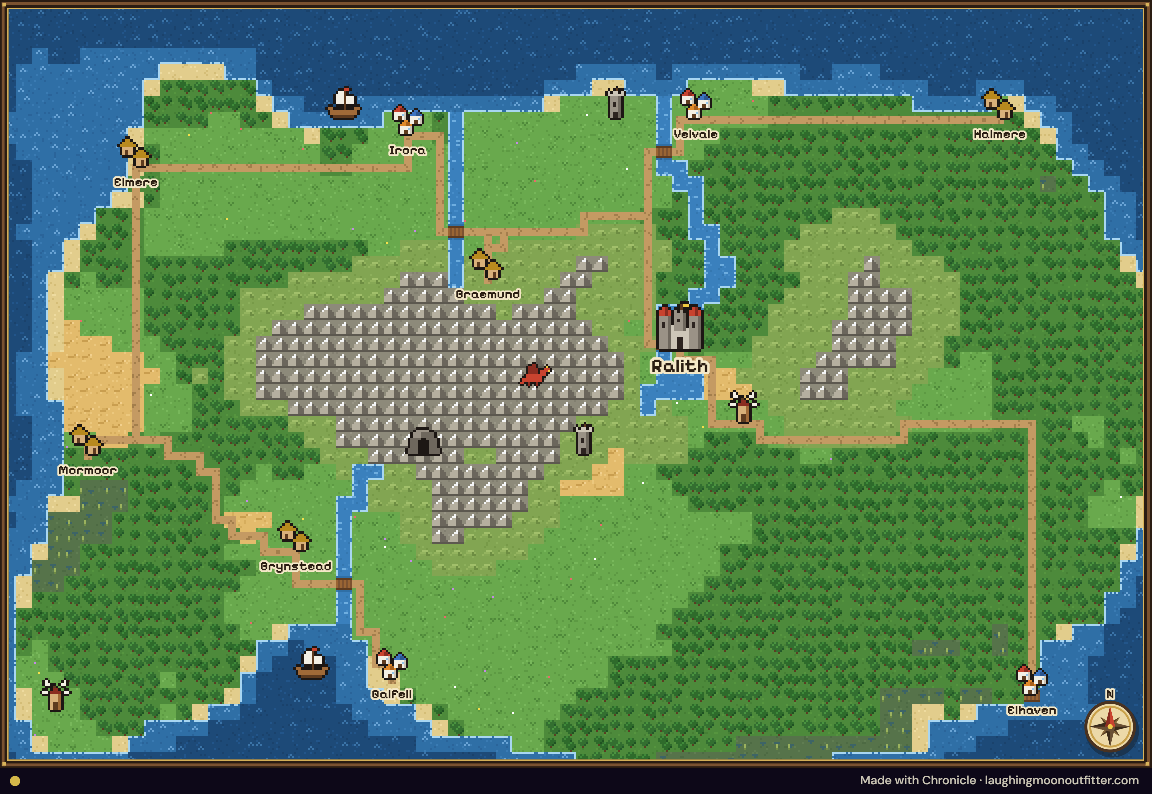
Then connect them. Roads follow rivers and coasts and go around mountains, not over them. A bridge or a pass is a natural place for a scene: an ambush, a toll, a meeting. On my map above, the castle sits where the river meets the road, which tells you who controls the trade.
Step 4: Name Everything
Names do a lot of worldbuilding on their own. A trick that works well: give each region its own sound. If the north uses hard sounds like "Bjorn" and "Kold" and the south uses soft ones like "Sela" and "Mira", readers feel two cultures without you explaining anything.
If names don't come easily, use the free place name generator for towns, rivers, mountains and ruins, and the fantasy name generator for the people who live there. Pick one sound per region and keep generating until a few names feel like they belong together. I wrote more about this in How to Name Fantasy Characters and Places.
Step 5: Leave Some Blank Space
Your map doesn't need to show everything. In fact, it's better if it doesn't. A map usually shows what the people in your world know, so the edges can stay empty, foggy or marked with a single "here be dragons". Those blank spaces are where your sequel lives.
Trace your hero's route with your finger. Does it pass through every place the story needs? Does anything feel too close or too far for the time it takes in your chapters? Fix the map now, not after chapter twenty.
Common Mistakes to Avoid
- Rivers that split on the way to the sea, or run uphill.
- Every town the same size. Most places should be villages, a few towns, and one or two cities.
- Deserts and snow right next to each other with no mountains or distance between them.
- Too many labels. If it's not in the story, it doesn't need a name yet.
- A map that never changes. Kingdoms fall and borders move. Your map should be allowed to move with your history.
Make Your Map for Free
Everything above, you can do in the free fantasy map maker. It draws pixel maps right in your browser, with no account needed:
- 23 terrains: sea, rivers, sand, grass, forests, hills, mountains, snow, desert, swamp, lava, roads and more.
- 40 stamps: castles, towns, towers, caves, ships, trees and markers.
- Labels and a title: name every place, with a banner, a compass and a frame.
- Download it: save your map as a PNG to use anywhere.
Want a whole world instead of one land? The planet generator spins up a planet with moons and rings that you can download too.
Then Use It While You Write
A map is most useful when it's next to your story, not in a folder. That's what Chronicle is for (full disclosure, it's my own tool). Your timeline, characters and chapters live there, and your first history is free with no credit card.
With the Full Moon plan ($6 a month) your map comes inside too: draw it with the same map maker or upload one, pin each place, then move the time slider to watch your story travel and follow your characters' trails across it.
If you make a map with this guide, I'd love to see it. Tell me about your world in the comments below.